Loading
A world that wraps is not a wind tunnel. Following a parcel through periodic, closed and channel domains.
Explore the recorded preview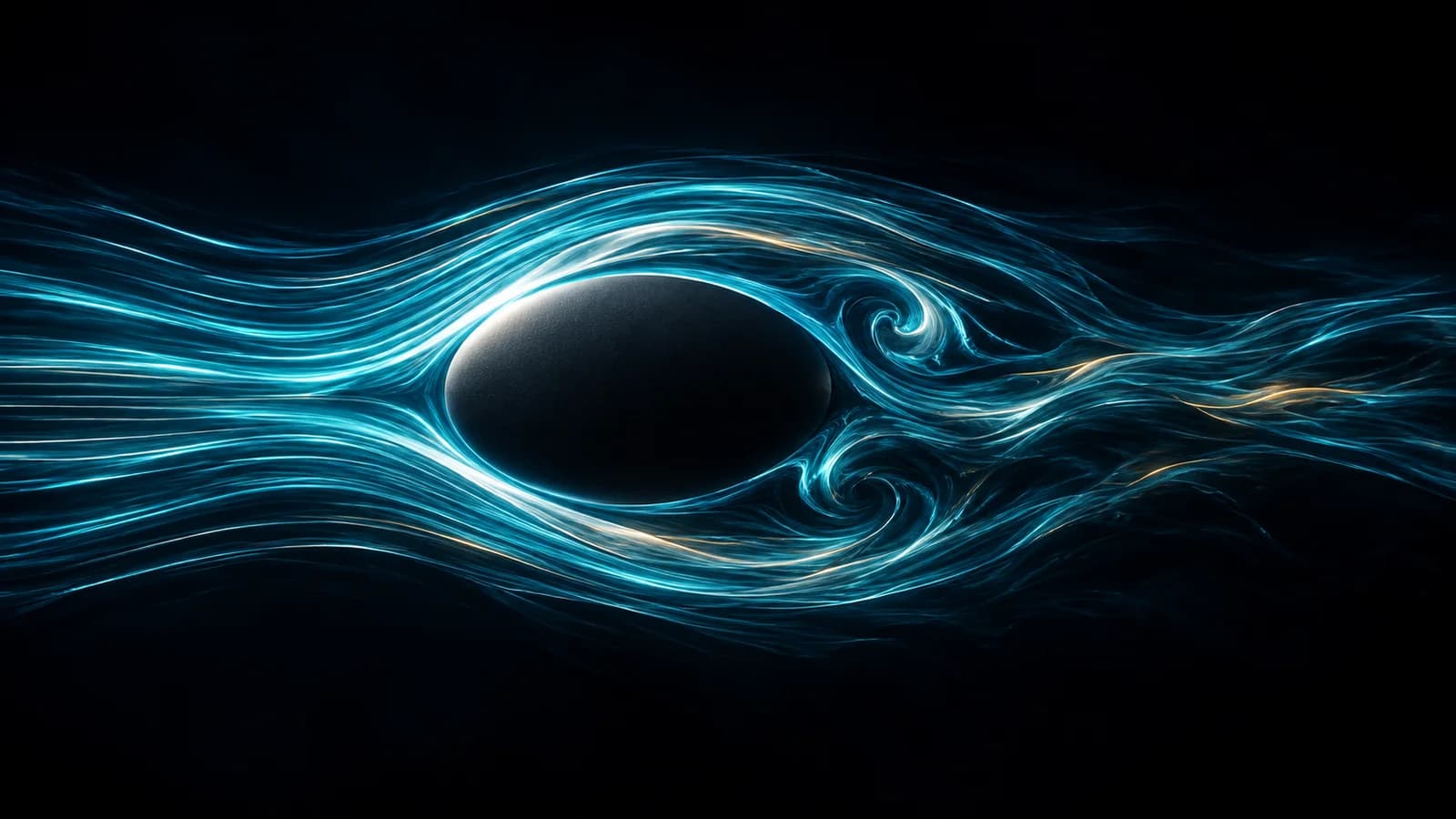 0808 / 10
A parcel reaches the edge of the picture. Does it return on the opposite side, stop at a wall, or leave the experiment?
Until that question is answered, “the same fluid” is an incomplete description. Boundary conditions are part of the model, not a frame placed around an otherwise finished simulation.
In a periodic world, opposite edges are neighbors. Material leaving one side reappears through the matching side. There is no fresh inlet, and an apparent crossing is not an escape from the domain.
In a closed domain, walls constrain normal flow. Tangential conditions also matter: no-slip and free-slip walls do not impose the same physics. A dark border in a screenshot does not tell you which one was used.
A channel adds an inlet and an outlet. An obstacle then interacts with a supplied flow, and the wake depends on the whole arrangement. The equations in the interior are only part of the experiment.
Boundary schematic only. Lines show domain organization, not measured streamlines or a validated wake.
The lines are a schematic of those arrangements, not measured streamlines. No vortices are generated by clicking the channel button. That restraint is intentional: a diagram can explain a boundary without pretending to validate a wake.
For a viscosity fork on the same periodic geometry, copying the complete state is the right control. For two different obstacle geometries, copying fields cell for cell can be wrong: a location that holds fluid in one world may be solid in the other.
The internal wake comparison therefore uses separate matched rest initializations under the declared geometries. “Matched” means the intended common conditions agree, not that every storage location has the same meaning. The comparison needs its own contract rather than a reused slogan about exact copies.
This is one reason evidence cannot be carried between backends casually. A periodic exact-copy check and a channel geometry check answer different questions.
The inlet control is a mean speed. A volumetric flow rate also requires a cross-sectional area; in a two-dimensional model, a flux is commonly interpreted per unit depth. Calling a speed a flow rate silently changes both the quantity and its units.
Even the word “speed” needs care. In a prescribed parabolic inlet profile, the centerline value is not the mean value. The ramp in time is another condition: an immediate full-speed inlet and a gradual startup do not provide the same initial transient.
When comparing wakes, record the mean inlet setting, profile, ramp, obstacle shape and size, domain dimensions, timestep and observation interval. A Reynolds number, if used, must state the reference speed and length. Without those definitions it is a label rather than a reproducible condition.
An outlet close to an obstacle may influence the flow you want to study. A longer channel can change that influence. Resolution can move features; transient structure can be mistaken for a developed regime.
A convincing wake image therefore does not establish a validated shedding frequency, drag coefficient or turbulent regime. Such claims require their own diagnostics, durations, refinements and sensitivity checks. Watching a short sequence repeat is not enough.
The general-engine catalog historically completed 25 of 105 cases, with the remainder deferred. The focused periodic work described in Part 7 does not fill those channel gaps. The public wake guide remains an explanation attached to the fixed preview, not a newly computed obstacle experiment.
The practical improvement is simple: include a domain diagram next to the first wake figure. Label inlet, obstacle, walls and outlet. State which condition changes between panels and which remain fixed. If a result is preliminary, say so before a reader turns an appealing pattern into a validated physical conclusion.
The edge is not outside the science. It is where the experiment tells the fluid what world it lives in.
Next: how to make that world readable without adding physics through the renderer.
More to read
A ten-unit run lost 5.115% of its dye. Keep the failed observation, change the transport method, measure again.
Light, color and a convincing surface can all mislead. Change the display while holding the numbers still.
Four faces, one balance sheet. Why velocities live between cells, and why pressure is a global correction.